Description
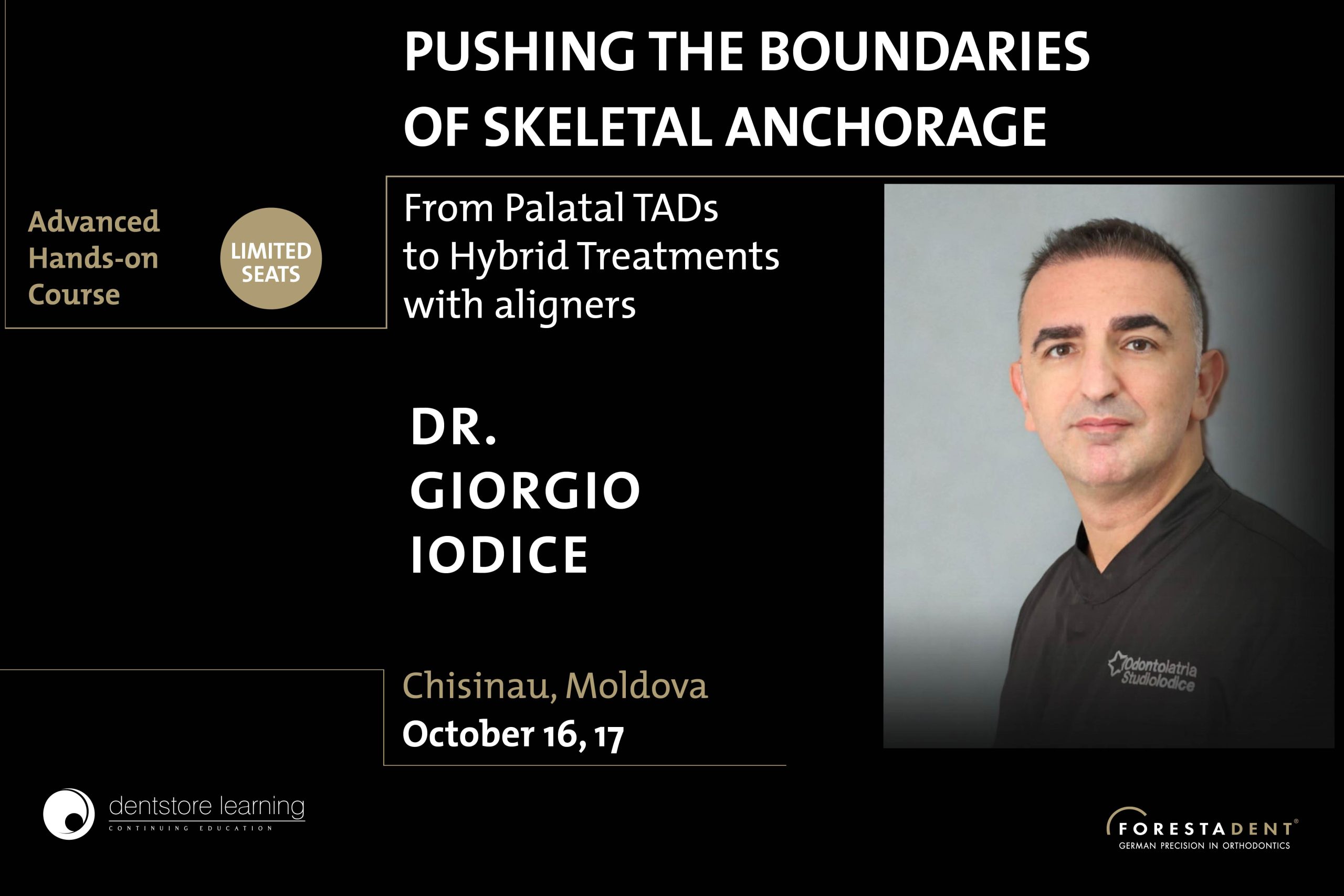
This two-day advanced course is designed to provide a comprehensive understanding of modern orthodontic treatment, combining skeletal anchorage and aligner therapy into a coherent and clinically applicable approach.
The program follows a structured progression:
Day 1 is fully dedicated to advanced skeletal anchorage, focusing on biomechanics, clinical protocols, and hands-on experience with palatal and extra-alveolar TADs.
Day 2 is focused on aligner therapy, starting from fundamental concepts and progressing towards hybrid treatments, integrating skeletal anchorage to overcome biomechanical limitations.
- DAY 1 Advanced Skeletal Anchorage and HANDS-ON session
The first day explores the full potential of modern skeletal anchorage systems, including the latest TADs designs, components, and clinical applications.
Participants will gain a detailed understanding of:
• digital 3D planning and guided insertion protocols
• biomechanics in Class II and Class III treatments
• vertical control and deep bite management
• palatal skeletal anchorage for maxillary expansion
• maxillary distalization strategies
• management of failures, risks, and complications
• integration of skeletal anchorage with aligners (hybrid approach)
Clinical case presentations will provide real-world insight into different treatment scenarios.
A key component of this day is the hands-on session, where participants will:
• perform TAD placement in different anatomical sites (palatal to infra-zygomatic)
• work with scan bodies and clinical workflows
• apply the “Elephant” abutment
• practice biomechanical management using power arms and cantilevers
- DAY 2 Aligners and Hybrid Treatments
The second day focuses on aligner therapy using the FAS system, guiding participants through the entire clinical workflow — from diagnosis to treatment completion.
Participants will explore:
• diagnostic protocols with emphasis on vertical, sagittal, and transverse relationships
• case submission and workflow using the FAS portal
• treatment planning strategies for improved efficiency and predictability
• staging analysis and movement planning
• OcclusalDesign® principles
• attachments, auxiliaries, and interproximal reduction (IPR) protocols
The course also includes the use of advanced diagnostic tools such as CBCT, arch registration, and mandibular dynamics.
Special emphasis is placed on clinical case management, from routine treatments to complex cases.
Building on the biomechanics developed on Day 1, participants will learn how to integrate skeletal anchorage with aligners, creating effective hybrid treatment protocols for challenging clinical situations.